




The Power Broker

Voor wie wil begrijpen hoe macht werkelijk werkt: Caro's onderzoek naar Robert Moses en New York.
4,6 · 102.285 winkelbeoordelingen
Specificaties
Maatvoering · ± 13,5 × 21,5 × 2,4 cm
3D
oorspronkelijk Engels
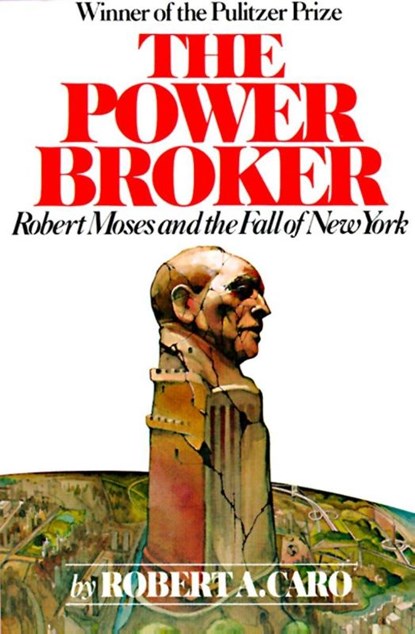
Achterkant niet als foto beschikbaar
ISBN 9780394720241
The Power Broker · Robert A. Caro
Maten geschat op de uitvoering.
Biografie
Biografie: het genre van dit boek.
Robert A. Caro
iedereen
Lezers geïnteresseerd in politieke geschiedenis, stedelijke planning en machtsdynamieken.
meeslepend
confronterend · prikkelend
macht en politiekstedelijke ontwikkelingNew Yorkdemocratiecorruptieinvloed
Pulitzer Prize
Waar gaat het over
Dit monumentale werk portretteert Robert Moses, een man die zonder gekozen positie enorme macht vergaarde en New York gedurende decennia vormgaf. Caro onthult hoe Moses buiten het democratische systeem opereerde, miljarden dollars aan openbare werken realiseerde, en tegelijkertijd de stad transformeerde van groene parken naar een verstedelijkt landschap. Het boek biedt inzicht in hoe politieke macht werkelijk functioneert in Amerika.
Achterflap
Everywhere acknowledged as a modern American classic, winner of the Pulitzer Prize, and chosen by the Modern Library as one of the hundred greatest books of the twentieth century, The Power Broker is a huge and galvanizing biography revealing not only the saga of one man's incredible accumulation of power, but the story of the shaping (and mis-shaping) of New York in the twentieth century.<br><br> Robert Caro's monumental book makes public what few outsiders knew: that Robert Moses was the single most powerful man of his time in the City and in the State of New York. And in telling the Moses story, Caro both opens up to an unprecedented degree the way in which politics really happens-the way things really get done in America's City Halls and Statehouses-and brings to light a bonanza of vital information about such national figures as Alfred E. Smith and Franklin D. Roosevelt (and the genesis of their blood feud), about Fiorello La Guardia, John V. Lindsay and Nelson Rockefeller.<br><br> But The Power Broker is first and foremost a brilliant multidimensional portrait of a man-an extraordinary man who, denied power within the normal framework of the democratic process, stepped outside that framework to grasp power sufficient to shape a great city and to hold sway over the very texture of millions of lives. We see how Moses began: the handsome, intellectual young heir to the world of Our Crowd, an idealist. How, rebuffed by the entrenched political establishment, he fought for the power to accomplish his ideals. How he first created a miraculous flowering of parks and parkways, playlands and beaches-and then ultimately brought down on the city the smog-choked aridity of our urban landscape, the endless miles of (never sufficient) highway, the hopeless sprawl of Long Island, the massive failures of public housing, and countless other barriers to humane living. How, inevitably, the accumulation of power became an end in itself.<br><br> Moses built an empire and lived like an emperor. He was held in fear-his dossiers could disgorge the dark secret of anyone who opposed him. He was, he claimed, above politics, above deals; and through decade after decade, the newspapers and the public believed. Meanwhile, he was developing his public authorities into a fourth branch of government known as "Triborough"-a government whose records were closed to the public, whose policies and plans were decided not by voters or elected officials but solely by Moses-an immense economic force directing pressure on labor unions, on banks, on all the city's political and economic institutions, and on the press, and on the Church. He doled out millions of dollars' worth of legal fees, insurance commissions, lucrative contracts on the basis of who could best pay him back in the only coin he coveted: power. He dominated the politics and politicians of his time-without ever having been elected to any office. He was, in essence, above our democratic system.<br><br> Robert Moses held power in the state for 44 years, through the governorships of Smith, Roosevelt, Lehman, Dewey, Harriman and Rockefeller, and in the city for 34 years, through the mayoralties of La Guardia, O'Dwyer, Impellitteri, Wagner and Lindsay, He personally conceived and carried through public works costing 27 billion dollars-he was undoubtedly America's greatest builder.<br><br> This is how he built and dominated New York-before, finally, he was stripped of his reputation (by the press) and his power (by Nelson Rockefeller). But his work, and his will, had been done.
Tekst van de uitgever, voorgelezen door Yellowbello.
De The Power Broker is goed in

Als cadeau ★★★★
Een bestseller: de veilige keuze als je de smaak van de ontvanger niet precies kent.
Om iets van op te steken ★★★★
Een leven als les: biografie.

Voor op vakantie
Veeleisend proza — eerder een boek voor de bank dan voor het strand.
Spanning van begin tot eind
Dit boek is niet geschreven om spannend te zijn.
Om bij weg te dromen
Dit boek mikt op je hoofd, niet op je hart.
Om voor te lezen
Geen kinderboek.
Productdetails
Everywhere acknowledged as a modern American classic, winner of the Pulitzer Prize, and chosen by the Modern Library as one of the hundred greatest books of the twentieth century, The Power Broker is a huge and galvanizing biography revealing not only the saga of one man's incredible accumulation of power, but the story of the shaping (and mis-shaping) of New York in the twentieth century.
Robert Caro's monumental book makes public what few outsiders knew: that Robert Moses was the single most powerful man of his time in the City and in the State of New York. And in telling the Moses story, Caro both opens up to an unprecedented degree the way in which politics really happens-the way things really get done in America's City Halls and Statehouses-and brings to light a bonanza of vital information about such national figures as Alfred E. Smith and Franklin D. Roosevelt (and the genesis of their blood feud), about Fiorello La Guardia, John V. Lindsay and Nelson Rockefeller.
But The Power Broker is first and foremost a brilliant multidimensional portrait of a man-an extraordinary man who, denied power within the normal framework of the democratic process, stepped outside that framework to grasp power sufficient to shape a great city and to hold sway over the very texture of millions of lives. We see how Moses began: the handsome, intellectual young heir to the world of Our Crowd, an idealist. How, rebuffed by the entrenched political establishment, he fought for the power to accomplish his ideals. How he first created a miraculous flowering of parks and parkways, playlands and beaches-and then ultimately brought down on the city the smog-choked aridity of our urban landscape, the endless miles of (never sufficient) highway, the hopeless sprawl of Long Island, the massive failures of public housing, and countless other barriers to humane living. How, inevitably, the accumulation of power became an end in itself.
Moses built an empire and lived like an emperor. He was held in fear-his dossiers could disgorge the dark secret of anyone who opposed him. He was, he claimed, above politics, above deals; and through decade after decade, the newspapers and the public believed. Meanwhile, he was developing his public authorities into a fourth branch of government known as "Triborough"-a government whose records were closed to the public, whose policies and plans were decided not by voters or elected officials but solely by Moses-an immense economic force directing pressure on labor unions, on banks, on all the city's political and economic institutions, and on the press, and on the Church. He doled out millions of dollars' worth of legal fees, insurance commissions, lucrative contracts on the basis of who could best pay him back in the only coin he coveted: power. He dominated the politics and politicians of his time-without ever having been elected to any office. He was, in essence, above our democratic system.
Robert Moses held power in the state for 44 years, through the governorships of Smith, Roosevelt, Lehman, Dewey, Harriman and Rockefeller, and in the city for 34 years, through the mayoralties of La Guardia, O'Dwyer, Impellitteri, Wagner and Lindsay, He personally conceived and carried through public works costing 27 billion dollars-he was undoubtedly America's greatest builder.
This is how he built and dominated New York-before, finally, he was stripped of his reputation (by the press) and his power (by Nelson Rockefeller). But his work, and his will, had been done.
- Categorie Non-fictie en Maatschappij
- EAN 9780394720241
Alle specificaties (21)
- Auteur Robert A. Caro
- Genre Biografie
- Subgenre Politieke biografie
- Thema's macht en politiek · stedelijke ontwikkeling · New York · democratie · corruptie · invloed
- Stemming confronterend · meeslepend · prikkelend
- Tempo gemiddeld
- Leesniveau veeleisend
- Leeftijdsgroep volwassene
- Voor wie iedereen
- Los te lezen Ja
- Speelt in (tijd) 20e eeuw
- Speelt in (plaats) New York
- Oorspronkelijke taal Engels
- Prijzen Pulitzer Prize
- Bestseller Ja
- Verfilmd Nee
- Waargebeurd Ja
- Achterflap Everywhere acknowledged as a modern American classic, winner of the Pulitzer Prize, and chosen by the Modern Library as one of the hundred greatest books of the twentieth century, The Power Broker is a huge and galvanizing biography revealing not only the saga of one man's incredible accumulation of power, but the story of the shaping (and mis-shaping) of New York in the twentieth century.<br><br> Robert Caro's monumental book makes public what few outsiders knew: that Robert Moses was the single most powerful man of his time in the City and in the State of New York. And in telling the Moses story, Caro both opens up to an unprecedented degree the way in which politics really happens-the way things really get done in America's City Halls and Statehouses-and brings to light a bonanza of vital information about such national figures as Alfred E. Smith and Franklin D. Roosevelt (and the genesis of their blood feud), about Fiorello La Guardia, John V. Lindsay and Nelson Rockefeller.<br><br> But The Power Broker is first and foremost a brilliant multidimensional portrait of a man-an extraordinary man who, denied power within the normal framework of the democratic process, stepped outside that framework to grasp power sufficient to shape a great city and to hold sway over the very texture of millions of lives. We see how Moses began: the handsome, intellectual young heir to the world of Our Crowd, an idealist. How, rebuffed by the entrenched political establishment, he fought for the power to accomplish his ideals. How he first created a miraculous flowering of parks and parkways, playlands and beaches-and then ultimately brought down on the city the smog-choked aridity of our urban landscape, the endless miles of (never sufficient) highway, the hopeless sprawl of Long Island, the massive failures of public housing, and countless other barriers to humane living. How, inevitably, the accumulation of power became an end in itself.<br><br> Moses built an empire and lived like an emperor. He was held in fear-his dossiers could disgorge the dark secret of anyone who opposed him. He was, he claimed, above politics, above deals; and through decade after decade, the newspapers and the public believed. Meanwhile, he was developing his public authorities into a fourth branch of government known as "Triborough"-a government whose records were closed to the public, whose policies and plans were decided not by voters or elected officials but solely by Moses-an immense economic force directing pressure on labor unions, on banks, on all the city's political and economic institutions, and on the press, and on the Church. He doled out millions of dollars' worth of legal fees, insurance commissions, lucrative contracts on the basis of who could best pay him back in the only coin he coveted: power. He dominated the politics and politicians of his time-without ever having been elected to any office. He was, in essence, above our democratic system.<br><br> Robert Moses held power in the state for 44 years, through the governorships of Smith, Roosevelt, Lehman, Dewey, Harriman and Rockefeller, and in the city for 34 years, through the mayoralties of La Guardia, O'Dwyer, Impellitteri, Wagner and Lindsay, He personally conceived and carried through public works costing 27 billion dollars-he was undoubtedly America's greatest builder.<br><br> This is how he built and dominated New York-before, finally, he was stripped of his reputation (by the press) and his power (by Nelson Rockefeller). But his work, and his will, had been done.
- In één zin Biografie van Robert Moses, de machtigste man achter New Yorks transformatie in de 20e eeuw.
- Waar gaat het over Dit monumentale werk portretteert Robert Moses, een man die zonder gekozen positie enorme macht vergaarde en New York gedurende decennia vormgaf. Caro onthult hoe Moses buiten het democratische systeem opereerde, miljarden dollars aan openbare werken realiseerde, en tegelijkertijd de stad transformeerde van groene parken naar een verstedelijkt landschap. Het boek biedt inzicht in hoe politieke macht werkelijk functioneert in Amerika.
- Voor wie Lezers geïnteresseerd in politieke geschiedenis, stedelijke planning en machtsdynamieken.
Aangeboden door Libris
Dit product wordt aangeboden door Libris, met een winkel in 's-Hertogenbosch. Koop lokaal en profiteer van extra service:
Boekhandel Van Kooten
Nu gesloten-
Zandstraat 143
3905 EB Veenendaal - 0318-512915
- libris.nl
Openingstijden
| Maandag | 08:30-17:30 |
| Dinsdag | 08:30-17:30 |
| Woensdag nu | 08:30-17:30 |
| Donderdag | 08:30-17:30 |
| Vrijdag | 08:30-17:30 |
| Zaterdag | 08:30-17:00 |
| Zondag | Gesloten |
Meer producten van Boekhandel Van Kooten

Vergelijkbare producten






€30,99
- Koop vertrouwd bij Libris
- Nu af te halen
- Altijd welkom in de winkel